TikTok has 1.5 billion monthly active users. Only 34 of the 100 most influential churches in the world have an active account on it.
Sit with both halves of that. One of the largest discovery platforms ever built, and roughly two-thirds of the churches with the most online influence on earth aren’t posting there at all. We know, because we counted.
That gap is the whole reason for this article. Not because TikTok is the future of ministry — it almost certainly isn’t, and we’ll get to why. But because there is an open lane on a massive platform right now, and open lanes don’t stay open.
The Number That Should Get Your Attention
We built something at REACHRIGHT this year called the Church Influence 100 — a deep-dive study to pin down, as empirically as we could, the 100 most influential churches in the world. We looked at every social platform, website presence, search volume, the whole picture. Some of these churches are enormous. Some run a few hundred people and punch far above their weight.
Here’s what floored us: only 34 of the 100 had an active church TikTok account. And the ones that did were seeing it move the needle on their overall influence. The correlation was not subtle.
So the honest read is that there’s an opportunity on TikTok available to basically every church — and almost nobody in the influence tier has taken it.
Before we go further, our standard disclaimer, because it matters more than anything else in this article: do one platform well rather than two halfway. We would much rather see a church hyper-focused on a single platform than spread across seven with nothing posted in months. If you don’t have the bandwidth for TikTok, don’t start. Count the cost first. But if you do have it, this is a real opening.
We should also admit up front: we are not TikTok experts. Neither of us uses it much. One of us deleted the app a few years ago specifically because it was too good at holding attention — the algorithm was designed too well to be healthy for a busy person. The other one only opens it through the REACHRIGHT account when his wife sends him something funny, watches it, leaves a “haha” emoji, and gets on with his life.
We’re not TikTok people. We are people who’ve spent years watching churches use social media as a ministry tool, and that’s the lens here.
What Facebook Taught Us About Renting an Audience
You may remember the day TikTok went dark in the U.S. — the ban that arrived, briefly, and then didn’t stick. It feels like a lifetime ago. That’s kind of the point.
But rewind further, because there’s a more useful story. Facebook used to work like this: if you liked a page, you saw that page’s posts. That was the deal. So churches — ours included — invested real work and real dollars in getting people to like their pages. We had systems built for it. We could reliably buy a page like for around 30 cents. Spend $100, get 300 new people who would see everything you posted from then on. It was the wild west, and as an outreach tool it was genuinely powerful.
Then the algorithm shifted, and organic page reach fell to under 4% of the people who followed you. Overnight. Every dollar spent building that audience stopped compounding.
Which is why we push churches so hard toward owned platforms — the ones where you actually own the audience instead of renting it. Chief among them: email. We’re aware nobody watches our email marketing videos. They’re boring and nobody clicks them. But email has been a working discipline for 25 years and it’s more valuable today than it’s ever been, which is more than TikTok will ever be able to say.
But “Temporary” Doesn’t Mean “Not Worth It”
Here’s the correction we’d make to our own cynicism.
Those thousands of dollars our churches spent on Facebook page likes weren’t actually wasted. In the years that it worked, it worked. People saw the posts. People showed up. People joined. The strategy had a shelf life, and we got full value out of the shelf life.
TikTok is the same bet. It will not be here forever. Even setting aside the ban question, no platform stays culturally dominant — Facebook was everything, then Instagram was everything, then TikTok. The churches showing up on the Influence 100 list are the ones that were great at Facebook groups a decade ago and then adapted when the ground moved.
So: capitalize on what’s working now, keep your adaptability, and don’t put every egg in one basket. Be great at TikTok because it’s working right now. When it stops working, move.
Everything we’re about to tell you is going to be obsolete. If you’re reading this in 2030, ignore the tactics. The posture — find the platform with the open lane, do it well, be ready to leave — that part travels.
TikTok Is a Search Engine Now
Most people think of TikTok purely as discovery. You scroll, it feeds you, you stumble onto things you didn’t know you wanted. That’s real. But it’s not the biggest opportunity for churches.
The biggest opportunity is that a whole generation now uses TikTok as a first-stop search engine.
Going out to eat? Search restaurants in the area — on TikTok, not Google. Planning a Disney World trip? Best rides, best snacks — TikTok. This sounds strange if you’re not in it, but it’s simply how a large chunk of Gen Z finds information now, and the behavior keeps expanding.
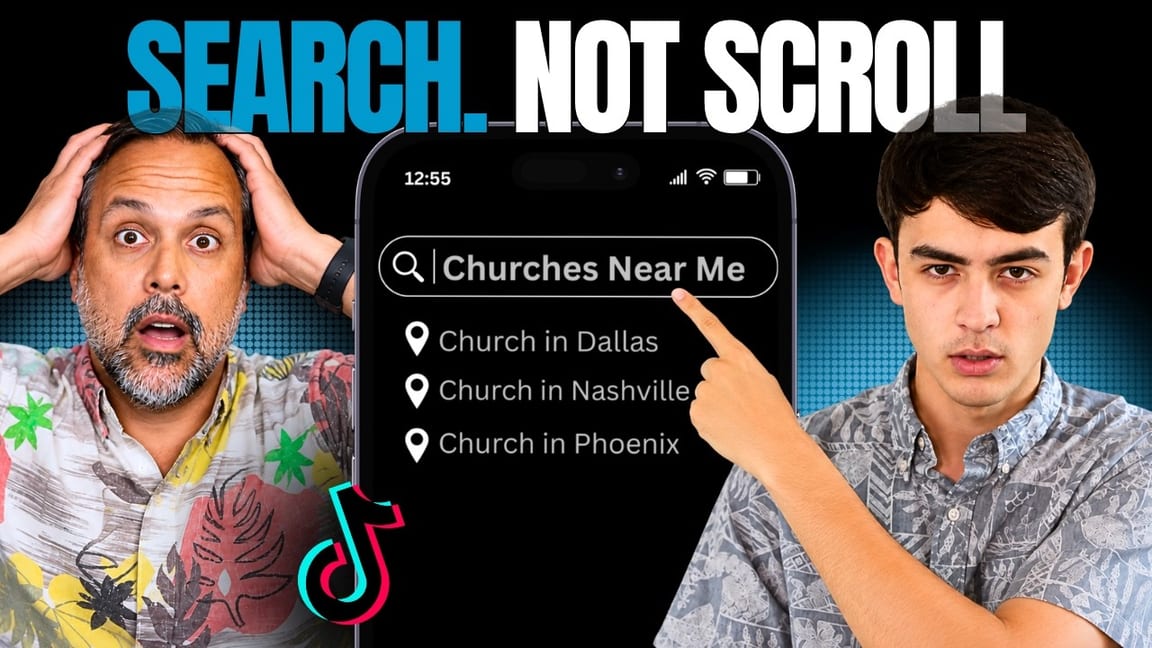
So here’s an exercise. Stop reading, pull out your phone, open TikTok, and search “churches in [your town].”
We’ve run this test in a lot of places. What comes back is almost always thin. Very few churches are optimizing anything for people searching TikTok for a church. That’s ground zero — it means you can be found two different ways on the same platform: through the feed, and through the search bar. And practically nobody is competing for the second one.
If a Gen Z person in your city searches “churches near me” on TikTok and your church doesn’t appear, that isn’t a small gap. That’s an open field.
The Asymmetry Test
Here’s the rule of thumb we use for evaluating any platform: look for asymmetry. You want somewhere a lot of people are, that is not saturated with your kind of content.
TikTok is at the top of that hill right now. It’s far more widely used than most church leaders realize — behind only YouTube and Instagram in active users — and a lot of our audience is still mentally filing it under “that’s the dance video app.” Meanwhile it has nowhere near the volume of sermon clips, church content, and ministry accounts that YouTube or Instagram carry.
That asymmetry is the entire opportunity. And it won’t last.
To be clear about the timing: joining TikTok in 2026 does not make you an early adopter. That window was during COVID. But relative to Facebook, relative to Instagram, arguably relative to YouTube, you are still much earlier in the curve. Early enough to matter.
One quick generational map, painting with a broad brush: Facebook skews boomer and Gen X. Instagram skews millennial. TikTok skews Gen Z. YouTube is where Gen Alpha lives — and, honestly, most other generations too.
What Actually Works on TikTok Right Now
Value-first watch time
The algorithm shifted this year toward what gets called value-first watch time. Thirty-to-sixty-second videos that teach something or tell a story are now being rewarded over fast-cut hype clips and ten-second meme content, which is what used to blow up.
That’s good news for churches, because ministry is fundamentally about giving something of value. Sharing a word. Teaching a passage. Praying for the person watching. Offering an insight worth sixty seconds. The content churches are naturally positioned to make is the content TikTok is now built to push.
Captions are non-negotiable
Over 70% of TikTok users watch with sound off at some point. That number sounds bonkers, but it’s the reality. If anyone is speaking in your video, it needs burned-in captions. No exceptions.
This is one of the more defensible uses of AI in ministry — let a tool generate the captions, then actually proof them before you post. CapCut will do this easily.
The text-on-screen video (start here)
If you only take one tactic from this article, take this one. It’s the easiest content you can possibly make, and it’s what we’re measuring real results from right now.
Take B-roll — either life at your church, or just a beautiful spot in your community. For us that’s China Walls, a cliff overlooking the ocean. Don’t write this off as a Hawaii thing. A peaceful field in your county works exactly as well. Capture thirty seconds of it. Then overlay one main point from Sunday’s sermon, stylized for the platform and phrased in a way that’s actually interesting.
That’s the whole video.
We tried it at our church and got a comment from someone asking what time our services were. That’s the funnel working, from a video that took almost no production.
Here’s the shortcut for producing them: drop your sermon transcript into Claude and ask it to distill a short blurb you can put over a text-on-screen video for TikTok. That’s a five-minute job that can produce a month of posts.
Pair it with trending audio
One addition that meaningfully raises the ceiling on those videos: use a trending sound. TikTok’s popular audio turns over week by week — you’ll see a new wave of videos all using the same song. Pick something current and reasonably relevant to the mood of your clip. It costs nothing and it’s often the difference between a video that sits and a video that travels.
”Come to church with me”
One of the most durable formats on TikTok is the visit-with-me video. Come to this restaurant with me. Come to this nail salon with me. Someone voices over casual footage — here’s what we ordered, here’s the vibe, I’d give it a seven out of ten. It’s a vlog and a review compressed into sixty seconds.
We have not seen many churches do the church version of this, and we think somebody should. Come to a Sunday morning at my church with me. Here’s worship. They were handing out coffee and donuts in the lobby. Here’s what the message was about.
It seems mundane, and that’s exactly why it works elsewhere — people genuinely watch a stranger walk through getting a matcha. The format is proven. The church version is basically untested. If you try it, tell us how it goes.
Gamified videos
Quizzes do absurd numbers on TikTok across every topic, and the church version translates cleanly. One church we’ve come across films Bible trivia at a pool: two people standing on a weighted plank, and every question they miss removes another weight, until someone goes in the water. There’s an obvious payoff you’re waiting for, and while you wait, you’re absorbing Bible trivia.
You don’t need to do that specific bit. The principle is that formats already exploding on the platform can usually be pulled into a ministry context, and almost nobody has done it yet.
How Often to Post
You do not need to post every day. TikTok isn’t quite that kind of platform for a church.
Three to five quality posts per week is the right cadence for most churches. And given how fast a text-on-screen video comes together, that’s very achievable.
For churches we manage social for, the plan we recommend most is two sermon-clip videos plus one carousel per week — carousels being the swipeable posts, usually reinforcing a point from the message over footage of people from your church or local landmarks. A clean rhythm: clip Monday, carousel Wednesday, clip Friday. Do that consistently and you’re ahead of nearly every church in your area.
Could you post daily? Sure, and it probably wouldn’t hurt you. But you’ll hit diminishing returns, and we’d rather you spend that energy occasionally making one higher-effort video — a quiz, a come-with-me — to see what breaks through. Keep experimenting, keep adjusting.
Put the Pastor’s Face on Camera
This matters more than production value, and it isn’t close.
The videos that perform on TikTok are usually not the beautifully shot, perfectly edited ones. They’re the ones where a viewer connects with the person on screen. That’s how influencers become influencers — an iPhone, a face, and a way of talking to people directly.
There’s a whole category of AI-driven “faceless” channels making real money on these platforms, and the platforms are increasingly trying to weed that content out. Faces win. We’re wired for it from infancy — people connect with people far more readily than with objects, logos, or brands. “New Hope” is less interesting than “Pastor Pat.” That’s not a knock on your church name; it’s just how humans work.
But the reach is the smaller half of the argument. Here’s the bigger one.
Your goal on TikTok is not to be a big TikTok channel. Monetizing TikTok should be at the absolute bottom of your church’s priority list. The goal is helping people engage with the gospel, walk into your building, get connected, join a team, grow into leaders and evangelists. TikTok is the top of that funnel, not the destination.
And every shred of evidence we have says people choose a church, more often than not, because they feel some connection to the pastor. So if a visitor arrives on Sunday having already watched your pastor talk directly to camera fifteen times, they walk in with a relationship already partly formed. Their odds of sticking go way up.
We’ll be the first to say we’re not in the business of building pastor brands — that’s not our MO. But this is how the platforms work, and it happens to serve a genuinely pastoral end.
Social Media Is Social
We forget this constantly, because advertising swallowed the whole category. But the platforms reward accounts that behave like humans: responding to comments, making videos in response to suggestions, treating the comment section as a conversation instead of a metrics dashboard.
Our rule — and we think every church under a thousand people should adopt it — is that you respond to every single comment. Make it a blanket policy and set a response-time standard. Ours is within an hour when we can. Right away is better. Overnight is too late.
When you don’t know what to say, respond in kind:
- Someone leaves praise-hands? Send an emoji back. A fire emoji basically always works.
- Someone says “amen”? Emoji back.
- Someone asks a heartfelt question? Actually answer it.
- Someone pushes back on something your pastor said in a sermon clip, in good faith? Don’t delete it. Respond. Have the conversation. Your community watching you engage a real disagreement graciously is a feature, not a liability.
- Someone takes a cheap shot — “you all believe a fairy tale from 2,000 years ago”? That one you can quietly remove.
Where you can, write replies that invite more replies. Ask a question back. Pull the rest of the comment section into it. That’s proven to push a video further.
And use the platform’s native social mechanics — stitching trending questions, responding to things people are already asking.
Here’s why this isn’t a soft, nice-to-have discipline. Remember that text-on-screen video with the ocean footage? Someone commented asking what time our services start. Our team answered quickly. We don’t yet know whether that person shows up — it only happened this week. But we know with certainty they definitely wouldn’t have if nobody had answered.
That’s the whole ballgame. One comment, answered fast, is worth more than a hundred thousand views nobody replied to.
Where TikTok Actually Ranks
After all that, here’s the honest placement: third.
1. YouTube. If you count it as social — and we do — it’s the biggest opportunity in church media, full stop. You can still reach your subscribers, the notification bell still works, it’s a genuine discovery engine, and what people discover there frequently leads them into full sermons and real discipleship. Plus you’re already filming your services. The value is overwhelming.
2. Instagram. For an American audience across all age groups, people are still more likely to be on Reels than on TikTok. You’ll get more mileage per post.
3. TikTok. Which puts it above Facebook — surprising to a lot of people — and above X, Threads, LinkedIn, and everything else.
That ranking is for a fairly vanilla church. If you’re pastoring in an urban area reaching mostly college students and people in their twenties, move TikTok up. If your congregation skews older, it may not be worth the bandwidth at all yet.
But for most churches with the capacity to run three platforms well, TikTok has earned the third slot. The audience is enormous, the search behavior is real, the content is cheap to make, and almost none of your peers are there.
Open lanes close. This one is still open.
Your Next Step
Not sure where your church actually stands across TikTok, Instagram, YouTube, and your website? We offer a free church marketing and website review. Our team will look at your digital front door, your social presence, and your overall strategy, then send back honest, specific recommendations you can actually use. No sales pitch. Real feedback.
Turnaround is about 48 hours. It’s free for any church that asks.
More Resources
- Introducing the Church Influence 100: The Most Influential Churches Online
- 11 Easy TikTok Content Ideas for Churches
- 15 Excellent Tips for Using TikTok for Churches
- Which Social Media Platforms Are Actually Worth a Church’s Time?
- Ranking the Most Powerful Ways to Reach Gen Z in 2026
- Your Church Needs a Social Media Manager (And the Intern Doesn’t Count)