

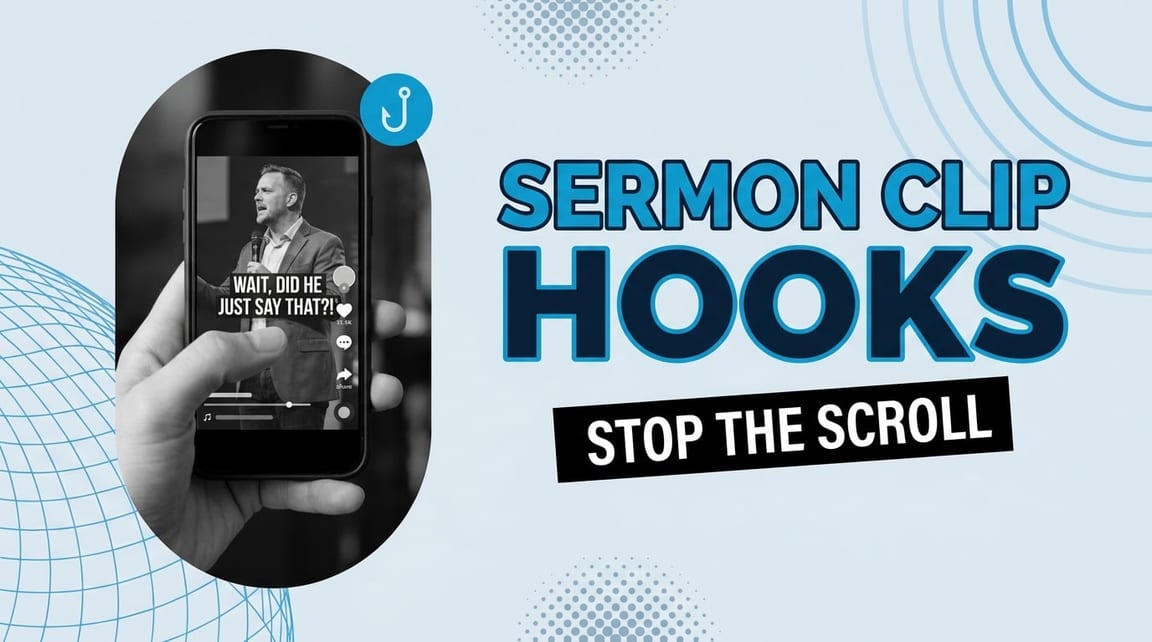
Your pastor just preached the best sermon of the year. The clip got 312 views. The hook is the reason.
At REACHRIGHT we’ve watched thousands of sermon clips across hundreds of churches. The clips that work and the clips that die are separated by the first three seconds. Not the preaching. Not the production. The first line of on-screen text and the first sentence out of the pastor’s mouth.
This guide hands you 7 proven sermon clip hooks, 25 sermon-specific examples you can adapt this week, a bad-vs-good rewrite table, and a 4-step process for turning a preaching line into a scroll-stopping opener. Plus the First 3 Seconds Rule that governs everything else.
Why Church Clips Die in the First 3 Seconds
The scroll is a reflex, not a decision. TikTok, Reels, and Shorts retrain the brain to flick unless something interrupts. Viewers form an impression in roughly 1.7 seconds. When three-second retention drops below 65%, the algorithm stops distributing you.
Most church clips open with the four things that kill watch time fastest:
- A black-screen intro card with the sermon series branding
- The pastor mid-sentence: “So as we were talking about last week…”
- A three-second worship B-roll fade
- A Scripture reference with no context (“Romans 8:28…”)
What stops the scroll is different. A claim. A confession. A question. A contradiction. A cliffhanger. It lands in the first one to two seconds, usually on-screen text, and it earns the viewer’s attention before the sermon starts doing any theological work.
The First 3 Seconds Rule
The first 3 seconds of a sermon clip do one job: earn the next 3.
If second 2 sounds like second 1, you lose. If the viewer has to wait for the pastor to warm up, you already lost. Every sermon clip needs a hook that lands before the sermon does.
If you want a broader framework for what makes church social media posts actually perform, start there. This post zooms in on the one element that decides whether any of it gets seen.
The 7 Hook Formulas That Work for Sermons
These formulas come from direct-response copywriting and short-form video, adapted for the pulpit. Every one of them rides on the same engine: interrupt the scroll, then earn the next three seconds. Use them as starting points, not scripts.
| # | Formula | Structure | Sermon Example (on-screen text) |
|---|---|---|---|
| 1 | The Contrarian | "Most Christians think X. They're wrong." | "Most Christians pray wrong. And nobody wants to say it." |
| 2 | The Confession | "I used to believe ___. Then ___ happened." | "I was a pastor for 12 years before I understood grace." |
| 3 | The Open Loop | Start a story, cut before the payoff. | "My marriage almost ended over a text message..." |
| 4 | The Question Hook | Ask the question the viewer is already asking. | "Why does God feel far away when you need Him most?" |
| 5 | The Numbered Promise | "Here are 3 [things] that ___." | "3 signs you're praying from fear, not faith." |
| 6 | The Pattern Interrupt | Say what Christians aren't supposed to say. | "Yes, I've doubted God. Every disciple did too." |
| 7 | The Stat Grenade | Lead with a specific, unexpected number. | "73% of Christians can't explain the gospel in under 60 seconds." |
1. The Contrarian
Works because it breaks the script the viewer expects from a church account. The brain wants to resolve the contradiction, which means the viewer stays. Keep it honest. You’re pushing back on a shallow idea, not on Scripture.
More examples: “Tithing isn’t the point. Generosity is.” “Your quiet time isn’t working. Here’s why.” “Church attendance won’t save your marriage.”
2. The Confession
Vulnerability disarms skepticism. A pastor admitting something hard is the rarest thing in the feed, which is exactly why it stops the scroll. The rule: the confession has to be true, and the clip has to resolve it.
More examples: “I almost quit ministry last year. This is what changed.” “I was raised in church and didn’t meet Jesus until I was 34.” “I preached a sermon I didn’t believe. Once.”
3. The Open Loop
Start a story, then cut away before the punchline. The human brain hates unresolved narrative. Sugarman called it the slippery slide. Applied to sermons: tease the moment, deliver inside the clip, never break the promise.
More examples: “The text that ended our small group…” “What the deacon said after the service still haunts me…” “My daughter asked me one question I couldn’t answer…“
4. The Question Hook
The good ones name the question the viewer is already asking at 11 p.m. Weak question hooks ask what nobody wonders (“Have you ever thought about prayer?”). Strong ones ask what keeps people awake.
More examples: “What if you’ve been reading the Bible wrong?” “What does God do when you stop believing?” “Why do good people leave the church?“
5. The Numbered Promise
Numbers stop the scroll because they promise bounded value. The viewer knows what they’re about to get. Odd numbers outperform even. Small numbers (3, 4, 5) beat large ones for sermon clips because the clip has to deliver them all.
More examples: “4 lies pastors tell themselves.” “3 prayers God never ignores.” “5 things Jesus said that nobody quotes.”
6. The Pattern Interrupt
Say the thing Christians aren’t supposed to say out loud, then make it biblical. This is not outrage bait. It’s surfacing a tension the congregation already feels and refusing to pretend it isn’t there.
More examples: “You don’t need more faith. You need less fear.” “Stop reading your Bible like a textbook.” “The church isn’t the problem. We are.”
7. The Stat Grenade
A specific, unexpected number forces the viewer to stop calculating the scroll and start calculating the stat. The number has to be real, sourced, and relevant. Round numbers feel made up. “Two in three” beats “most.”
More examples: “Only 39% of churchgoers read the Bible weekly.” “Church attendance drops 62% between ages 18 and 25.” “1 in 3 pastors have considered quitting this year.”
Every one of these has to pass one test. Would a real pastor say this from a stage? If yes, use it. If it sounds like clickbait, cut it.
Hook Mistakes That Kill Watch Time
Seven deadly sins of sermon clip openers. Each one trains the algorithm to bury your account.
- Opening with a Scripture reference instead of the tension inside the verse. “Romans 8:28” is not a hook. “What Paul said about your worst day is harder than you think” is.
- Starting with “last week we talked about…” Nobody in the feed was there last week. You just created context debt in the first two seconds.
- Intro cards and branded bumpers. Three seconds of series art before the pastor speaks is three seconds you gave back to the algorithm.
- A spoken hook without on-screen text. Most short-form video gets watched on mute. If the hook only exists in audio, 60%+ of the viewers never receive it.
- A hook that doesn’t deliver. If the opener promises “the one verse that changed my marriage” and the clip never names the verse, the viewer punishes you on the next one.
- Long setups. “I want to talk to you today about something really important…” burns 4 seconds to say nothing. Cut it.
- Cliche Christian language. “Have you ever wondered…” is a stall. The scroll keeps moving.
The source of most of these is a sermon that was written for a room and clipped for a feed. Fixing it starts with preaching. We cover that in the biggest communication mistakes preachers make.
Bad Hook vs. Good Hook: Before and After
Same sermon. Same clip. Different first sentence. The difference is whether anyone watches past second 2.
| Sermon Moment | Bad Hook (what most churches post) | Good Hook (what stops the scroll) |
|---|---|---|
| Message on forgiveness | "Today we're looking at forgiveness in Matthew 18..." | "The person you refuse to forgive is winning." |
| Message on anxiety | "Paul tells us not to be anxious about anything..." | "Anxiety isn't a lack of faith. But it's still trying to lie to you." |
| Message on giving | "We're continuing our series on stewardship..." | "You can't out-give God. Most Christians never find out." |
| Message on marriage | "Marriage was God's idea from the beginning..." | "Your marriage problem is a prayer problem." |
| Message on doubt | "Let's talk about having faith in tough seasons..." | "Doubt isn't the opposite of faith. Indifference is." |
The “bad” versions aren’t bad preaching. They’re bad openers for a feed. The sermon context was there in the room. On Instagram there is no context. The hook is the context.
How to Adapt a Preaching Opener Into a Scroll-Stopping Hook
A 4-step process your team can run in under 10 minutes per clip.
Step 1: Find the pastor’s sharpest sentence in the clip
Scan the transcript. Ignore the intro. Hunt for the line that would make someone lean forward, say “whoa,” or pull out their phone. That sentence is your hook candidate, not the sermon’s opening sentence. Most preachers bury their best line four minutes in. For a deeper method on this step, see picking the right sermon moments.
Step 2: Strip the setup
Most preachers front-load context. Cut it. If the line is “So as we’ve been reading through James, we see that anger doesn’t produce righteousness,” your hook is “Anger doesn’t produce righteousness.” Nine words became four. The meaning survived.
Step 3: Add friction
Rewrite the line so the viewer feels something in under a second. Tension. Surprise. Recognition. “Anger doesn’t produce righteousness” becomes “Your anger is costing you the life you want.” Same idea, harder edge, reader sees themselves.
Step 4: Put it on screen
The spoken hook and the text overlay don’t have to match word for word. The text is louder. Keep it under 10 words. Bold. High contrast. Top third of the frame so the caption bar doesn’t cover it on Reels.
If your pastor’s preaching already generates quotable lines, clipping gets easier by an order of magnitude. Two posts that help at the source: preaching without notes and the related skill of writing sermon titles that work the same way.
Real Examples From Church Accounts Doing This Well
Five composite case studies from churches we’ve observed. No real names. Every one of these hooks is biblically defensible and was actually preached.
- A 1,200-person suburban church. On-screen text: “Your marriage is not 50/50. It’s 100/100.” Formula: Contrarian. 38-second clip. Crossed 80,000 views in 10 days.
- A church plant of 70 people. On-screen text: “I used to think church was the point. I was wrong.” Formula: Confession. Pinned to the grid. Three first-time visitors traced back to it.
- A multi-site church. On-screen text: “What your kids actually need from you on Sundays…” Formula: Open Loop plus Question. Pastor answers at the 22-second mark. 71% completion rate.
- A rural church of 180. On-screen text: “2 in 3 teens quit church by 22. Here’s why mine stayed.” Formula: Stat Grenade plus Story. Stat sourced from LifeWay Research 2019. Shared 400+ times in the region.
- A traditional Baptist church of 400. On-screen text: “Pastors aren’t supposed to say this out loud.” Formula: Pattern Interrupt. Highest-performing clip of the year.
One pattern across all five: the church built a church social media strategy where clips were the anchor, not an afterthought. The hooks didn’t come from guessing. They came from a weekly process. The same hook principles apply to slide 1 of sermon carousels for Instagram, if you’re posting there too.
FAQ
Stop Writing Hooks From Scratch Every Week
You have a great sermon. You don't have time to turn it into 4 hooks, 4 clips, and 4 captions every Monday.
Our social media management team does it for you. We pull the strongest moments from Sunday's sermon, write scroll-stopping hooks using the exact formulas above, produce the clips, and post them for your church every week.
No new hires. No new software to learn. If you're still deciding between [DIY vs done-for-you sermon clips](/blog/diy-vs-done-for-you-sermon-clips/), the difference is usually what you do with Monday mornings.